September 6, 2026 · Coreventra
For Businesses: AI Support Chatbot Plan with KPIs and a 4–8 Week Pilot
Illustrative photo.
For Businesses: AI Support Chatbot Plan with KPIs and a 4–8 Week Pilot
Yes, most businesses handling repetitive inquiries should adopt one now, starting with an LLM-powered assistant connected to your knowledge base and helpdesk, not a rigid rule-based script. Run a four to eight week pilot on your highest-volume ticket type, such as order status or returns, before expanding scope. Ticket deflection and faster resolution times are usually visible within weeks, not quarters.
**TL;DR:**
Running a four to eight-week pilot on high-volume ticket types shows measurable improvements in ticket deflection and resolution speed within weeks.
LLM-powered assistants that pull answers from your knowledge base are best suited for most small and mid-sized businesses before considering agentic workflows.
Integrating connected systems like CRM and helpdesk platforms is crucial for automation that saves labor hours and enhances customer experience.
Continual monitoring of fallback rates, escalation patterns, and conversation drop-offs is essential for maintaining chatbot performance and accuracy.
Starting narrow, connecting all relevant platforms, and setting clear success metrics before launch are key to avoiding common failures and successful scalability.
What are the main approaches to an AI customer support chatbot?
Three approaches dominate the market, and picking the wrong one wastes both budget and goodwill with customers who hit a wall.
Rule-based bots follow decision trees. A customer picks from a menu, the bot matches keywords, and it returns a scripted answer. These are cheap and predictable, and they still work well for narrow, high-frequency questions like store hours or shipping policies. The catch: any question that deviates from the script sends the customer straight to a dead end.
LLM and NLP-powered assistants interpret free-text questions and pull answers from your documentation in real time. IBM describes this category as systems that combine large language models and natural language processing with connected knowledge sources, so the bot can hold a genuine conversation rather than pattern-match against a script, and it works alongside human agents rather than replacing the queue entirely, according to IBM's guide to AI customer service chatbots. This is the right starting point for most small and mid-sized businesses.
Agentic AI goes further: instead of just answering, it takes action, processing a refund, rebooking an appointment, or updating an account through connected APIs. Gartner forecasts that agentic AI could autonomously resolve up to 80% of common customer-service issues without human intervention in some scenarios by 2029, a substantial jump from today's assist-only bots, per the Gartner press release on agentic AI. That power comes with real risk, since a bot that can act on a system needs stronger permissions and guardrails than one that only talks.
Here's how to decide which tier fits your business:
Small team, low ticket volume, mostly FAQs: start with a rule-based or lightly LLM-assisted bot.
Growing support volume, varied questions, existing CRM data: invest in an LLM-powered virtual customer assistant with retrieval from your knowledge base.
High transaction volume, mature systems, appetite for automation risk: pilot agentic workflows for specific, low-risk actions like refunds under a set dollar threshold.
Internal help desk or IT support: consider an agent-assist tool that helps your own staff find answers faster, rather than a customer-facing bot at all.
Most organizations underestimate how much of their ticket volume a well-tuned LLM assistant can absorb before agentic automation is even necessary.
How does an AI customer support chatbot actually work?
The core mechanism is retrieval-augmented generation, or RAG. The chatbot takes a customer's question, searches your connected knowledge base for the most relevant passages, and feeds those passages to the language model alongside the question. The model then generates an answer grounded in your actual documentation instead of guessing from general training data. This is what separates a customer service AI that gives accurate, on-brand answers from one that invents plausible-sounding nonsense.
Getting there requires a specific technology stack, and vendors or internal teams should be able to speak to each piece:
A large language model for understanding and generating natural language responses.
An embeddings and retrieval layer that indexes your documents so relevant passages surface quickly.
Knowledge connectors to your help centre, product catalogue, and internal wikis.
Helpdesk and CRM integrations (Zendesk, Salesforce, Shopify, and similar platforms) so the bot can see order history, ticket status, and customer profiles, not just generic FAQ text.
An escalation layer that hands off cleanly to a human agent with full conversation context.
Integrations matter more than most decision-makers assume going in. A chatbot that only answers static questions is useful but limited. One connected to your CRM and order system can look up a specific customer's shipment, confirm a return window, or flag an account issue. This is where automation actually starts saving labour hours rather than just deflecting simple lookups, a distinction IBM's implementation guidance emphasizes for ecommerce and support-heavy businesses.
Before any of that works, someone has to prepare the data: product documentation, SOPs, past ticket transcripts, and return policies all need to be current and organized. Personally identifiable information in old ticket logs needs to be scrubbed or masked before it becomes training or retrieval data, a step that's easy to skip under deadline pressure and expensive to fix later.
Pro Tip: Audit your help centre articles for contradictions before connecting them to a chatbot. A bot fed two outdated versions of the same refund policy will confidently give the wrong one, and customers trust a wrong answer from a bot far less than a slow one from a human.
What ROI and KPIs should you expect from a support chatbot?
The headline benefits are straightforward: 24/7 coverage, fewer repetitive tickets reaching human agents, and faster first response on common questions. The harder part is proving it with numbers your finance team will accept.
Gartner's agentic AI forecast puts a ceiling on where this technology is headed: up to 80% autonomous resolution of common service issues by 2029, without human intervention in some scenarios. Treat that as a directional signal for where investment is heading, not a guarantee for your own contact centre.
Track these metrics from day one of any pilot, not after the fact:
Metric: Deflection rate — What it tells you: Percentage of inquiries the bot resolves without a ticket ever reaching an agent
Metric: Containment rate — What it tells you: Percentage of conversations the bot completes without escalation
Metric: Time to resolution — What it tells you: How much faster issues close compared to your pre-bot baseline
Metric: Escalation rate — What it tells you: How often the bot hands off, and whether that rate is trending down over time
Metric: CSAT — What it tells you: Whether customer satisfaction holds steady or improves after automation
Metric: Cost per contact — What it tells you: Blended cost across bot-handled and agent-handled tickets
IBM's guidance frames containment and CSAT as the two numbers that matter most in early pilots, since a bot that contains a high share of conversations but tanks satisfaction scores is solving the wrong problem. Interpret published industry benchmarks cautiously. Deflection rates vary enormously by industry, ticket complexity, and how well your knowledge base was prepared before launch, so a number that impressed a SaaS company's board might be irrelevant to a specialty retailer.
How do you implement a chatbot from plan to pilot to scale?
A rushed chatbot launch is how you end up with a bot that frustrates customers and gets quietly disabled six weeks later. A working prototype can be built quickly and cheaply, as one engineer documented with a functioning cloud-based bot running in a few hours for modest cost. Production-grade deployment, with governance and integrations, is a longer project. Here's the realistic sequence:
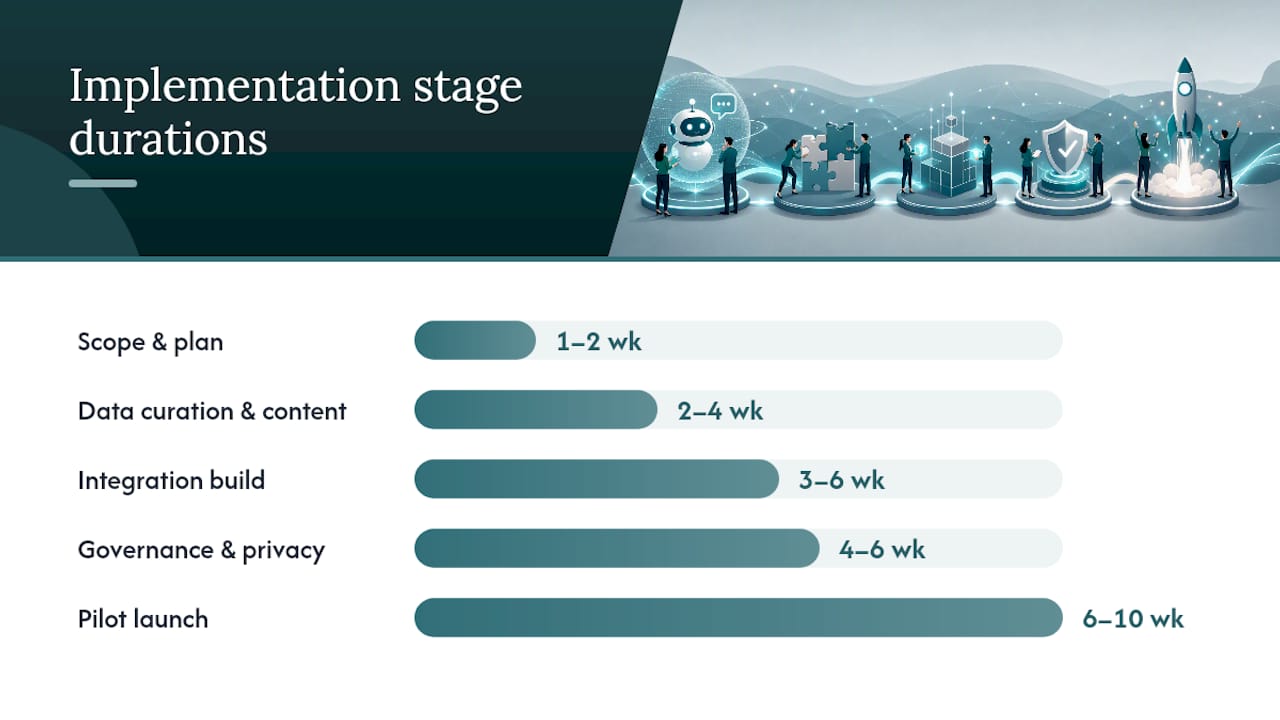
Scope and plan (week 1 to 2). Pick one high-volume use case, such as order status or appointment rescheduling. Resist the urge to solve everything at once.
Data curation and content authoring (week 2 to 4). Audit and clean your help centre articles, SOPs, and product data. Write or rewrite content specifically for retrieval, not just human browsing.
Integration build (week 3 to 6, often overlapping with curation). Connect the bot to your helpdesk, CRM, and any order or booking systems it needs to query.
Governance and privacy review (week 4 to 6). Define escalation rules, identity verification steps for account-specific requests, and a data retention policy for conversation logs.
Pilot launch (week 6 to 10). Deploy to a limited segment of traffic. Measure containment, deflection, and CSAT against your pre-launch baseline.
Evaluate and scale (week 10 onward). Expand scope only once pilot metrics hit your target thresholds, not on a fixed calendar date.
Guardrails deserve their own line item, not an afterthought bolted on before launch. IBM recommends the bot always offer an easy path to a human agent, maintain a consistent voice across every channel, and keep its knowledge base updated on a fixed cadence rather than left to go stale. If you're piloting any agentic capability, that's where identity verification and action limits matter most: a bot that can issue refunds needs tighter permission scoping than one that only answers questions, since the failure mode moves from a wrong answer to an unauthorized transaction.
Pro Tip: Set your pilot's success criteria before launch, not after you see the results. Agree on a target deflection rate and CSAT floor with stakeholders in week one, so nobody moves the goalposts once the numbers come in.
When choosing between building internally or hiring an agency, map the work against your team's actual bandwidth: data curation and content authoring can usually be done in-house, but integration work across helpdesk, CRM, and order systems, plus governance design, is where most internal teams stall out.
How do you measure and improve a chatbot after launch?
Launch is the beginning of the work, not the end of it. Chatbots degrade quietly: knowledge goes stale, phrasing drifts from how customers actually ask questions, and escalation thresholds that made sense at launch stop fitting six months later as your product or policies change.
Instrument these signals from day one:
Fallback rate — how often the bot fails to find a confident answer, which flags gaps in your knowledge base.
Escalation patterns — which topics trigger human handoff most, often revealing where documentation needs rewriting.
Conversation drop-off — where customers abandon a chat, a strong signal of a confusing flow.
Prompt and template performance — A/B test different phrasing for common responses to see which resolves faster.
A quarterly review cadence works for most businesses: check whether fallback rates are climbing, retrain or refresh the knowledge base against recent tickets, and revisit escalation thresholds based on what's actually driving handoffs. Practical pilots tend to succeed when they start with one high-volume use case and measure containment closely before adding scope, rather than expanding into five use cases simultaneously and losing the ability to tell which one is underperforming, a lesson borne out in documented small-scale chatbot builds. Treat governance as an ongoing job, not a one-time setup task.
How Coreventra supports AI chatbot implementation
Coreventra is a digital solutions agency. Chatbot projects rarely fail on the language model. They fail on the integration work: connecting a bot cleanly to a helpdesk, CRM, or order system, curating and structuring the knowledge base it draws from, and building the conversational interface customers actually see.
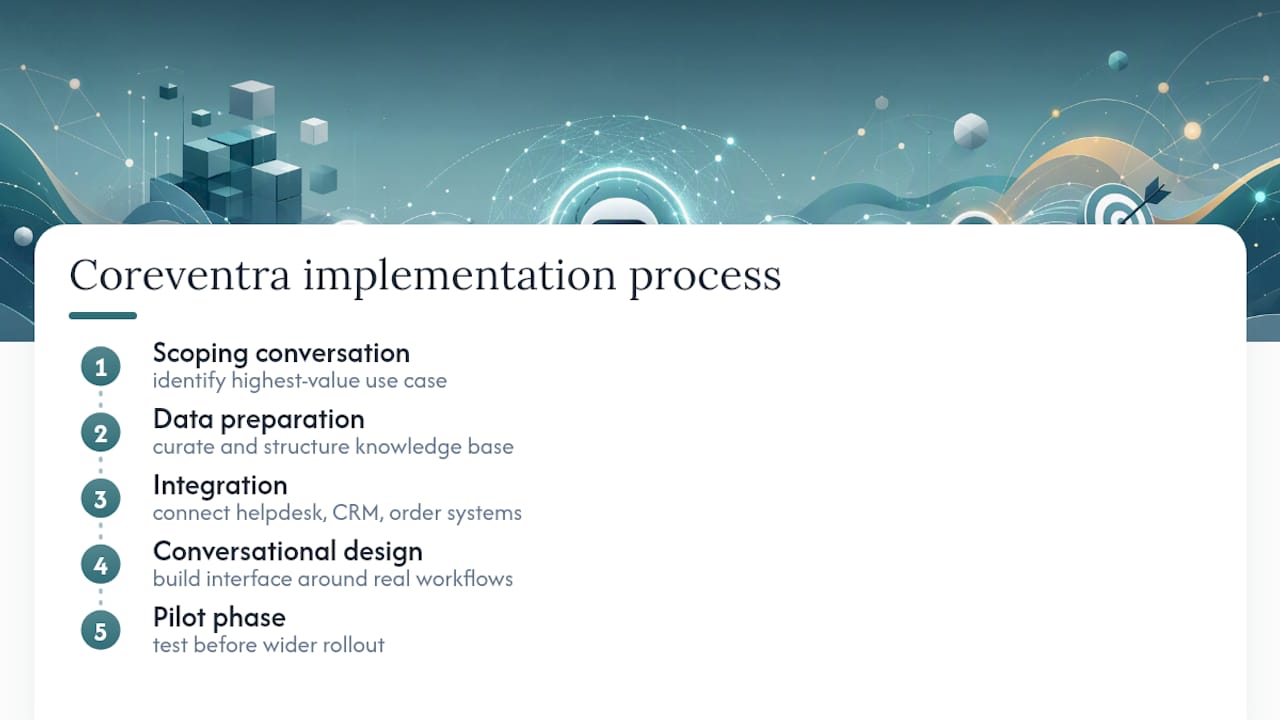
That's the scope Coreventra works within on AI and automation projects: data integration between existing business systems, custom web application development where an off-the-shelf platform doesn't fit, and conversational interfaces built around a business's real workflows rather than a generic template. The engagement process typically starts with a scoping conversation to identify the highest-value use case, then moves through data preparation, integration, and a pilot phase before wider rollout, mirroring the same sequence any serious chatbot project should follow regardless of who builds it.
What decision-makers consistently get wrong about chatbot projects
Three rules hold up across most chatbot projects: start narrow with one high-volume use case, insist on integrations before launch rather than after, and set your success metrics before the pilot begins, not once the numbers are already in front of you.
The two most common pitfalls both come from skipping steps. Businesses launch a bot on stale or contradictory documentation, and they connect no systems at all, leaving it able to talk but not actually help. Build internally when your team has real integration experience and time to spare. Hire an agency when the timeline is tight or the systems involved are more than one platform deep.
Get help building your AI customer support chatbot
If your business doesn't have an internal team with time to spare for integration work, data curation, and governance design, that's precisely where a managed build pays for itself. Coreventra offers services including system integration, custom web application development, and automation design that can connect chatbots to existing tools.
Rather than juggling a language model vendor, an integration contractor, and a governance framework separately, you get one team that has already sequenced this exact project: scope, data prep, integration, pilot, scale. If you're ready to move past the planning stage, book a discovery call through Coreventra's AI and automation services page to scope a pilot for your highest-volume support use case, or browse the full range of services if your project touches website or e-commerce work alongside the chatbot itself.
Sources
Gartner press release: agentic AI forecast
A guide to AI customer service chatbots | IBM
How I built a customer service chatbot in a few hours
Recommended
What a Trade Business Website Needs to Actually Generate Calls
A Website Speed & Mobile Checklist for Home Service Businesses